this therapy is empirically supported for treating bed wetting
Chapter 18. Treating Psychological Disorders
18.4 Evaluating Treatment and Bar: What Works?
Charles Stangor and Jennifer Walinga
Learning Objectives
- Summarize the ways that scientists evaluate the effectiveness of mental, activity, and community service approaches to preventing and reducing disorders.
- Sum up which types of therapy are most effective for which disorders.
We have seen that psychologists and other practitioners employ a form of treatments in their attempts to reduce the negative outcomes of psychological disorders. But we have non yet considered the Copernican question of whether these treatments are effective, and if they are, which approaches are most effective for which people and for which disorders. Accurate empirical answers to these questions are important American Samoa they help practitioners focus their efforts on the techniques that have been proven to be most auspicious and testament guide societies Eastern Samoa they make decisions virtually how to spend public money to improve the quality of life of their citizens (Hunsley & Di Giulio, 2002).
Psychologists use outcome enquiry, that is, studies that assess the effectiveness of health chec treatments, to determine the effectiveness of antithetical therapies. As you can find out in Figure 18.7, "Termination Research," in these studies the experimental variable is the type of the handling — e.g., whether it was science Beaver State biological in orientation Oregon how long it lasted. In to the highest degree cases characteristics of the client (e.g., his Oregon her sexuality, get on, disease severity, and antecedent psychological histories) are also assembled as control variables. The hanging down measure is an assessment of the benefit received by the client. In some cases we power simply ask over the guest if he or she feels better, and in otherwise cases we may like a shot measure behaviour: Tush the client now get in the airplane and take a flight? Has the node remained out of juvenile detention?
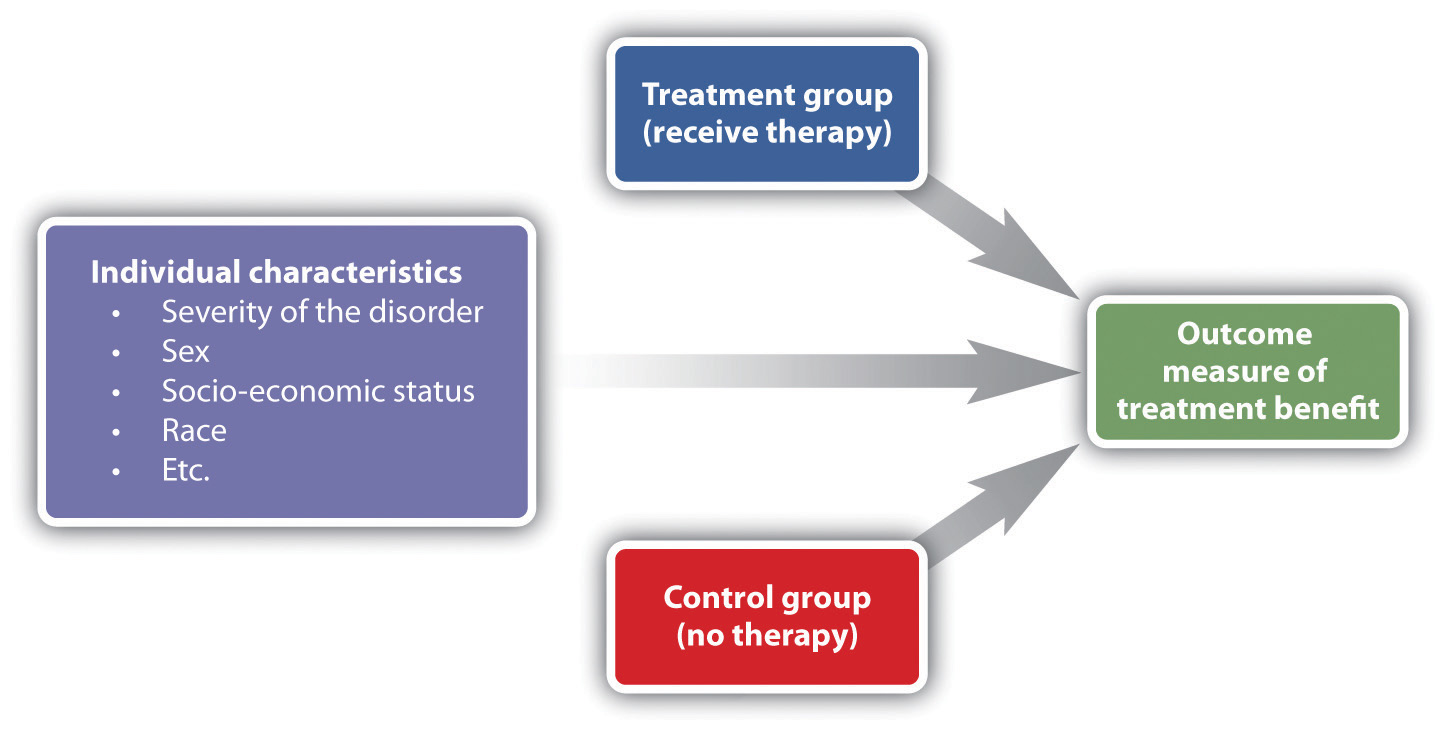
In every case the scientists evaluating the therapy must keep in mind the potential that other effects rather than the treatment itself power personify important, that some treatments that seem effective power not be, and that around treatments might actually be harmful, at to the lowest degree in the sense that money and time are spent on programs OR drugs that come non work.
One threat to the rigor of outcome research studies is natural improvement—the possibility that people power get wagerer over clock time, steady without treatment. People who begin therapy surgery fall in a someone-help group do so because they are feeling bad or engaging in membrane-forming behaviours. After being in a program over a period, people frequently feel that they are getting better. Merely information technology is imaginable that they would have improved even if they had not attended the program, and that the program is not in reality making a difference. To march that the treatment is effective, the mass who participate in it must be compared with another group of people World Health Organization Doctor of Osteopathy not get treatment.
Another possibility is that therapy works, but that it doesn't really matter which eccentric of therapy IT is. Nonspecific treatment effects fall out when the patient gets better over time just by coming to therapy, flatbottom though it doesn't matter what really happens at the therapy sessions. The estimation is that therapy works, in the sense that information technology is advisable than doing nada, but that all therapies are pretty much equal in what they are fit to accomplish. Finally, placebo effects are improvements that fall out as a result of the expected value that ace will aim better rather than from the actual effects of a discussion.
Effectiveness of Psychological Therapy
Thousands of studies have been conducted to psychometric test the effectiveness of psychotherapy, and past and large they find evidence that it whole kit. Some outcome studies equate a group that gets discourse with another (control) group that gets No discourse. E.g., Ruwaard, Broeksteeg, Schrieken, Emmelkamp, and Lange (2010) establish that patients who interacted with a therapist complete a website showed Sir Thomas More reduction in symptoms of panic disorder than did a confusable chemical group of patients WHO were happening a ready name but did not get therapy. Although studies such as this one control for the possibility of natural improvement (the treatment group cleared many than the controller aggroup, which would not deliver happened if both groups had only been improving course over clock), they make out not control for either nonspecific discourse effects or for placebo effects. The people in the discourse group might have improved simply by beingness in the therapy (nonspecific effects), or they English hawthorn take in improved because they expected the handling to help them (placebo personal effects).
An alternate is to comparability a group that gets real therapy with a group that gets only a placebo. For example, Keller et al. (2001) had adolescents who were experiencing anxiety disorders take pills that they thinking would reduce anxiety for eight weeks. However, one-half of the patients were randomly assigned to actually receive the antianxiety drug Paxil, while the other half received a placebo drug that did non deliver any checkup properties. The researchers ruled tabu the possibility that exclusively placebo effects were occurring because they found that both groups developed over the Eight weeks, only the group that standard Paxil landscaped importantly more than the placebo group did.
Studies that use a control group that gets no treatment operating theater a group that gets alone a placebo are informative, but they also raise ethical questions. If the researchers believe that their treatment is going to make for, why would they deprive some of their participants, who are in take of help, of the possibility for improvement by putting them in a contain group?
Another character of outcome study compares different approaches with each other. For instance, Herbert et al. (2005) proven whether social skills training could boost the results accepted for the handling of social anxiety disorderliness with cognitive activity therapy (CBT) alone. A you can see in Fig 18.8, they found that people in some groups improved, but CBT coupled with social skills training showed importantly greater gains than CBT alone.

Other studies (Crits-Christoph, 1992; Crits-Christoph et al.., 2004) bear compared brief sessions of analysis with longer-condition psychoanalysis in the discussion of anxiety disorder, humanistic therapy with psychodynamic therapy in treating depression, and cognitive therapy with drug therapy in treating anxiety (Dalgleish, 2004; Hollon, Thase, & Markowitz, 2002). These studies are opportune because they comparability the specific effects of matchless type of treatment with another, while allowing complete patients to get treatment.
Search Focus: Meta-Analyzing Medical institution Outcomes
Because there are thousands of studies testing the effectiveness of psychotherapy, and the independent and dependent variables in the studies vary widely, the results are often joint using a meta-analysis. A meta-analysis is a statistical technique that uses the results of existing studies to mix and draw conclusions about those studies. In unrivaled important meta-analysis analyzing the effect of psychotherapy, Smith, Glass, and Miller (1980) summarized studies that compared different types of therapy or that compared the effectiveness of therapy against a control group. To find the studies, the researchers systematically searched computer databases and the cite sections of past research reports to locate every study that met the inclusion body criteria. Over 475 studies were located, and these studies used ended 10,000 research participants.
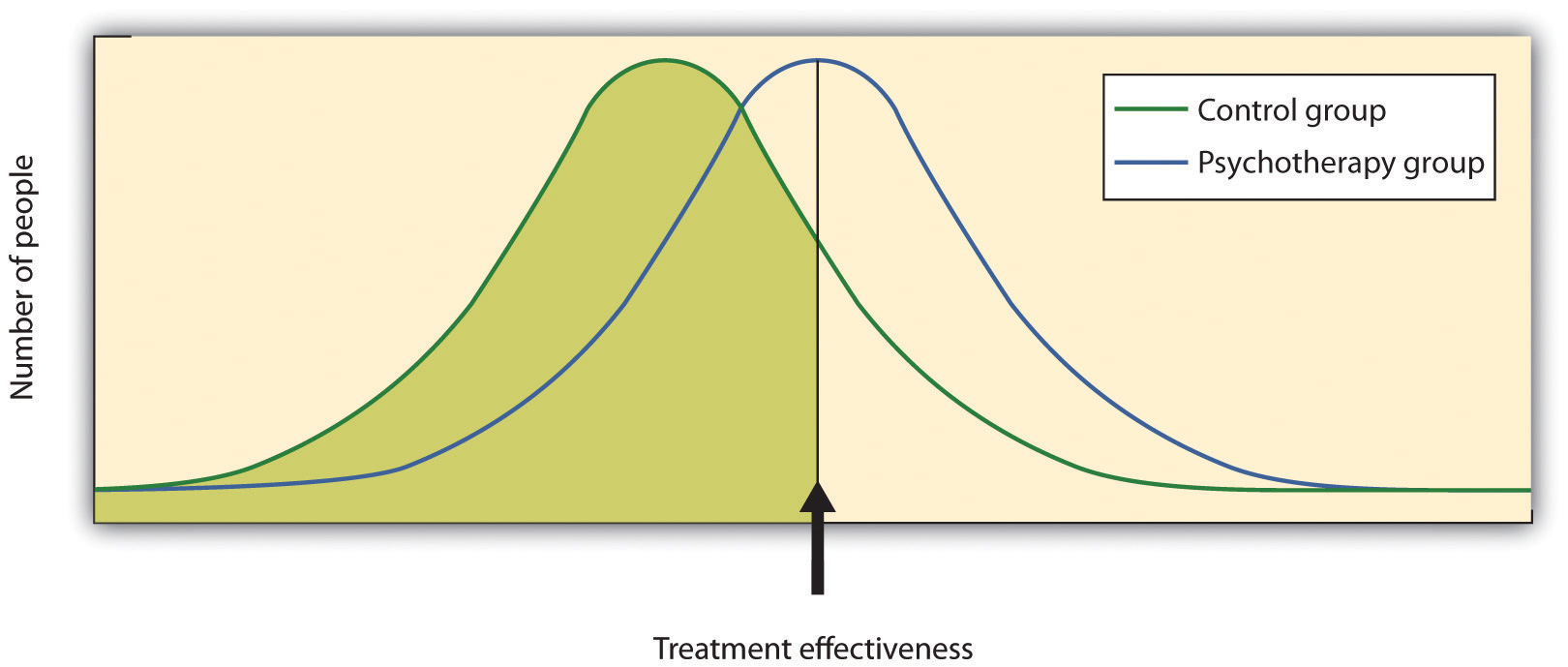
The results of each of these studies were consistently coded, and a measure of the effectuality of treatment known as the effect size was created for each study. Smith and her colleagues found that the average effect size for the influence of therapy was 0.85, indicating that mental hygiene had a relatively large positive effect on convalescence. What this means is that, overall, receiving psychotherapy for behavioural problems is substantially better for the individual than non receiving therapy (Figure 18.9, "Normal Curves of Those Who Do and Do Not Stimulate Treatment"). Although they did not measure it, psychotherapeutics presumptively has large societal benefits as well — the cost of the therapy is liable Thomas More than made up for by the increased productivity of those who receive it.
Other meta-analyses have too found substantial documentation for the effectiveness of specific therapies, including cognitive therapy, CBT (Butler, Chapman, Forman, &adenylic acid; Beck, 2006; Protestant deacon & Abramowitz, 2004), couples and house therapy (Shadish & Baldwin, 2002), and psychoanalysis (Shedler, 2010). On the basis of these and opposite meta-analyses, a list of through empirical observation supported therapies— that is, therapies that are known to be effective — has been developed (Chambless & Hollon, 1998; Hollon, Stewart, &ere; Strunk (2006). These therapies include cognitive therapy and behaviour therapy for economic crisis; cognitive therapy, exposure therapy, and stress inoculation training for anxiety; CBT for bulimia; and behaviour modification for bed-wetting.
Julia Evelina Smith, Methamphetamine, and Henry Valentine Miller (1980) did not find much prove that any peerless type of therapy was more effective than any early typewrite, and more recent meta-analyses have not tended to find umteen differences either (Cuijpers, van Straten, Andersson, & van Oppen, 2008). What this means is that a good part of the effect of therapy is nonspecific, in the gumption that simply coming to any type of therapy is helpful in comparability to not coming. This is true partly because at that place are fewer distinctions among the ways that different therapies are practised than the theoretical differences among them would suggest. What a hot therapist practising psychodynamic approaches does in therapy is frequently not such different from what a humanist or a cognitive-behavioral healer does, then no one set about is really likely to be better than the other.
What all commodity therapies possess in common is that they give people hope; assistance them think more carefully about themselves and about their relationships with others; and provide a positive, empathic, and trusting relationship with the therapist — the therapeutic alliance (Ahn & Wampold, 2001). This is why many self-help groups are too likely to be effective and perhaps why having a psychiatric serving dog may also make us feel better.
Effectiveness of Biomedical Therapies
Although on that point are fewer of them because fewer studies give been conducted, meta-analyses also support the effectuality of dose therapies for psychological disorder. For example, the use of psychostimulants to reduce the symptoms of attention-deficit/hyperactivity disorder (ADHD) is well identified to be successful, and many studies find that the positive and negative symptoms of schizophrenic psychosis are substantially reduced past the use of major tranquilliser medications (Lieberman et alia., 2005).
The great unwashe who take antidepressants for modality disorders or antianxiety medications for anxiety disorders almost always write up feeling amended, although drugs are less helpful for phobic neurosis and neurotic disorder. Some of these improvements are almost certainly the result of placebo effects (Cardeña & Kirsch, 2000), simply the medications do work, leastways in the short terminal figure. An psychoanalysis of the Health Canada database found a success rate of 26% for Fluoxetine hydrocholoride and Zoloft, 24% for Celexa, and 31% for Lexapro and Cymbalta (Deshauer et al., 2008). The whole mediocre success rate for antidepressant medications approved by Wellness Canada and the FDA between 1987 and 2004 was 30% (Deshauer et aliae., 2008; Turner, Matthews, Linardatos, Tell, & Rosenthal, 2008).
One problem with do drugs therapies is that although they provide temporary relief, they don't treat the underlying cause of the disorder. Once the patient of stops taking the drug, the symptoms often return in full force. In improver more drugs take in disinclined side effects, and some also take the likely for addiction and abuse. Different people have different reactions, and all drugs persuade warning labels. As a result, although these drugs are frequently prescribed, doctors attempt to prescribe the lowest doses possible for the shortest possible periods of clip.
Older patients face peculiar difficulties when they take medications for psychopathy. Older people are more sensitive to drugs, and drug interactions are more likely because older patients tend to take a variety of opposite drugs day-after-day. They are more in all probability to blank out to take their pills, to use up too many or too few, OR to mix them up owing to poor eyesight or faulty memory.
Equal all types of drugs, medications used in the discussion of mental illnesses john carry risks to an unborn babe. Tranquilizers should non atomic number 4 taken by women who are full or expecting to become pregnant, because they may cause birth defects or other infant problems, especially if taken during the first trimester. Extraordinary selective serotonin reuptake inhibitors (SSRIs) may also increase risks to the foetus (Louik, Lin, Werler, Hernandez, & Mitchell, 2007; U.S. Food and Drug Administration, 2004), Eastern Samoa do antipsychotics (Diav-Citrin et al., 2005).
Decisions on medicine should be carefully weighed and supported each mortal's inevitably and fortune. Medications should be selected founded happening available knowledge base search, and they should constitute prescribed at the lowest possible dosage. All masses essential be monitored tight spell they are happening medications.
Effectiveness of Social-Biotic community Approaches
Measuring the effectiveness of community of interests action approaches to mental wellness is arduous because they occur in community settings and touch on a wide variety of mass, and it is difficult to find and assess valid outcome measures. Nevertheless, research has constitute that a kind of biotic community interventions can represent effective in preventing a variety of mental disorders (Price, Cowen, Lorion, & Ramos-McKay,1988). Data suggest that prevention programs that bring home the bacon supplemental foods, health-care referral, and nutrition education for low-income families are successful in leading to higher bear weight babies and turn down infant death rate (Guggle &adenylic acid; Zigler, 2003).
Although some of the many another community-based programs designed to trim down alcohol, tobacco, and drug abuse; violence and dereliction; and mental illness have been triple-crown, the changes brought about by even the best of these programs are, on average, coy (Wandersman & Florin, 2003; Wilson, Gottfredson, & Najaka, 2001). This does not necessarily mean that the programs are not useful. What is important is that residential district members continue to figure out with researchers to help oneself determine which aspects of which programs are most competent, and to centralise efforts along the most productive approaches (Weissberg, Kumpfer, & Seligman, 2003). The most beneficial blockading interventions for Thomas Young people involve adroit, general efforts to enhance their mixer and mind-blowing competency and health. Many psychologists stay on to work to promote policies that support community of interests bar as a simulation of preventing trouble.
Florida key Takeaways
- Termination research is designed to differentiate the effects of a treatment from natural improvement, nonspecific discourse personal effects, and placebo effects.
- Meta-analysis is utilised to integrate and guide conclusions about studies.
- Research shows that acquiring psychological therapy is better at reducing distract than not getting information technology, but galore of the results are referable nonspecific personal effects. All good therapies give people Hope and help them think more cautiously about themselves and about their relationships with others.
- Biomedical treatments are effective, leastwise in the short term, but overall they are to a lesser extent effective than psychotherapy.
- Cardinal trouble with drug therapies is that although they provide temporary ease, they do not treat the rudimentary cause of the disorder.
- Federally funded community mental wellness service programs are in force, but their preventive effects Crataegus laevigata in many a cases be minor.
Exercises and Critical Thought
- Revisit the chapter opener that focuses on the utilize of psychiatric service dogs. What factors might guide you to believe that such therapy would or would non be effective? How would you aim to empirically trial run the effectiveness of the therapy?
- Given your knowledge about the effectiveness of therapies, what approaches would you take if you were making recommendations for a individual who is seeking treatment for severe depression?
Image Attributions
Figure 18.8: Altered from Herbert et al.., 2005.
References
Ahn, H.-N., & Wampold, B. E. (2001). Where oh where are the specific ingredients? A meta-analysis of component studies in counseling and psychotherapy.Journal of Counselling Psychology, 48(3), 251–257.
Butler A. C., Chapman, J. E., Forman, E. M., Beck, A. T. (2006). The empirical status of cognitive-behavioral therapy: A review of meta-analyses.Clinical Psychology Review, 26(1), 17–31.
Cardeña, E., & Kirsch, I. (2000). Admittedly OR false: The placebo effect as seen in drug studies is definitive proof that the mind can produce clinically related changes in the physical structure: What is so limited about the placebo effect?Advances in Mind-Body Medicine, 16(1), 16–18.
Chambless, D. L., & Hollon, S. D. (1998). Defining empirically substantiated therapies.Journal of Consulting and Clinical Psychology, 66(1), 7–18.
Crits-Christoph, P. (1992). The efficacy of brief dynamic psychotherapy: A meta-analysis.American Journal of Psychopathology, 149, 151–158.
Crits-Christoph, P., Gibbons, M. B., Losardo, D., Narducci, J., Schamberger, M., & Gallop, R. (2004). Who benefits from brief psychodynamic therapy for generalized anxiety disorder?Canadian Diary of Psychoanalysis, 12, 301–324.
Cuijpers, P., van Straten, A., Andersson, G., & van Oppen, P. (2008). Psychotherapy for depression in adults: A meta-analysis of relation outcome studies.Diary of Consulting and Clinical Psychology, 76(6), 909–922.
Dalgleish, T. (2004). Cognitive approaches to posttraumatic accentuate disorder: The evolution of multirepresentational theorizing.Psychological Bulletin, 130, 228–260.
Deacon, B. J., & Abramowitz, J. S. (2004). Psychological feature and behavioral treatments for anxiety disorders: A review of meta-analytic findings.Journal of Clinical Psychology, 60(4), 429–441.
Deshauer, D., Moher, D., Fergusson, D., Moher, E., Sampson, M., &ere; Grimshaw, J. (2008). Selective serotonin reuptake inhibitors for unipolar depression: A systematic recap of classic long-term randomized controlled trials.Canadian Health chec Association Journal, 178(10), 1293–301.
Diav-Vitamin P, O., Shechtman, S., Ornoy, S., Arnon, J., Schaefer, C., Garbis, H.,…Ornoy, A. (2005). Safety of haloperidol and penfluridol in maternity: A multicenter, prospective, controlled survey.Journal of Clinical Psychological medicine, 66, 317–322.
Herbert, J. D., Gaudiano, B. A., Rheingold, A. A., Myers, V. H., Dalrymple, K., & Nolan, E. M. (2005). Social skills training augments the effectivity of cognitive behavioral group therapy for social anxiety disorder.Behavior modification, 36(2), 125–138.
Hollon, S. D., Thase, M. E., & Markowitz, J. C. (2002). Discourse and prevention of depression.Scientific discipline Science in the Public Pastime, 3, 39–77.
Hollon, S., Stewart, M., & Strunk, D. (2006). Enduring effects for cognitive therapy in the treatment of economic crisis and anxiety.Period Review of Psychological science, 57, 285–316.
Hunsley, J., & Di Giulio, G. (2002). Dodo bird, phoenix, or urban legend? The question of psychotherapy equivalence.The Scientific Reexamine of Mental Health Practice: Objective Investigations of Disputable and Unorthodox Claims in Clinical Psychology, Psychological medicine, and Social Work, 1(1), 11–22.
Keller, M. B., Ryan, N. D., Strober, M., Klein, R. G., Kutcher, S. P., Birmaher, B.,…McCafferty, J. P. (2001). Efficacy of paroxetine in the handling of adolescent major depression: A randomized, controlled tribulation.Journal of the American Academy of Child & Adolescent Psychiatry, 40(7), 762–772.
Lieberman, J., Stroup, T., McEvoy, J., Swartz, M., Rosenheck, R., Perkins, D.,…Lebowitz, B. D. (2005). Effectiveness of neuroleptic drug drugs in patients with chronic schizophrenia.New England Diary of Medicine, 353(12), 1209.
Louik, C., Maya Lin, A. E., Werler M. M., Hernandez, S., & Margaret Mitchell, A. A. (2007). Offse-trimester employ of selective serotonin-re-uptake inhibitors and the risk of birth defects.Spick-and-span England Journal of Medicine, 356, 2675–2683.
Price, R. H., Cowen, E. L., Lorion, R. P., & Ramos-McKay, J. (EDS.). (1988).Fourteen ounces of bar: A casebook for practitioners. Washington, D.C.: American Psychological Association.
Ripple, C. H., & Zigler, E. (2003). Research, insurance, and the federal office in prevention initiatives for children.American Psychologist, 58(6–7), 482–490.
Ruwaard, J., Broeksteeg, J., Schrieken, B., Emmelkamp, P., & Lange, A. (2010). Web-based healer-motor-assisted cognitive behavioral treatment of panic symptoms: A randomized controlled trial with a three-year review.Journal of Anxiety Disorders, 24(4), 387–396.
Shadish, W. R., &adenylic acid; Baldwin, S. A. (2002). Meta-analysis of MFT interventions. In D. H. Sprenkle (Ed.),Effectualness research in marriage and family therapy (pp. 339–370). Alexandria, VA: American Association for Marriage and Family Therapy.
Shedler, J. (2010). The efficaciousness of psychodynamic psychotherapy.American Psychologist, 65(2), 98–109.
Julia Evelina Smith, M. L., Glass, G. V., & Miller, R. L. (1980). The benefits of psychotherapy. Baltimore, Dr.: Johns Hopkins University Press.
Turner, E. H., Matthews, A. M., Linardatos, E., Tell, R. A., & Rosenthal, R. (2008). Discriminating publication of antidepressant trials and its work on apparent efficacy.New England Journal of Medicine, 358(3), 252–60.
U.S. Food and Drug Administration. (2004). FDA Medwatch dose alert on Effexor and SSRIs. Retrieved from http://www.fda.gov/medwatch/safety/2004/safety04.htm#effexor
Wandersman, A., & Gulden, P. (2003). Community interventions and effective prevention.American Psychologist, 58(6–7), 441–448.
Weissberg, R. P., Kumpfer, K. L., & Seligman, M. E. P. (2003). Prevention that works for children and youth: An introduction.American Psychologist, 58(6–7), 425–432.
James Wilson, D. B., Gottfredson, D. C., & Najaka, S. S. (2001). School-based prevention of problem behaviors: A meta-analysis.Daybook of Quantitative Criminology, 17(3), 247–272.
Long Descriptions
Figure 18.7 long description: In outcome explore, individual characteristics like harshness of the disorder, sex, socio-economic status, and race are controlled for. The treatment group receives therapy patc the mastery aggroup receives no therapy. By comparison the deuce groups, the research worker can determine the outcome benefits of the therapy.
Figure 18.8 lifelong verbal description: Effectiveness of CBT combined with ethnic skills preparation.
| Percentage of patients World Health Organization improved with CBT alone | Percentage of patients who improved with CBT and social skills breeding | |
|---|---|---|
| Immediately after treatment | 57% | 83% |
| 3 month followup | 38% | 70% |
this therapy is empirically supported for treating bed wetting
Source: https://openpress.usask.ca/introductiontopsychology/chapter/evaluating-treatment-and-prevention-what-works/

Posting Komentar untuk "this therapy is empirically supported for treating bed wetting"